
Why Your Courier Can't Wait at Your Door
Learn why home delivery is the most expensive stage of the parcel journey, what challenges couriers face every day, and how secure parcel delivery boxes can reduce failed deliveries
Mark Naylor
7/3/20264 min read
Why Your Courier Can't Wait at Your Door
Most of us have experienced that moment.
You hear a knock on the door, but by the time you reach it, the delivery driver is already back in their van.
It's easy to think:
"Couldn't they have waited another minute?"
The reality is very different.
Modern delivery drivers work under enormous pressure. Every minute they spend waiting at one house affects every delivery still left on their route.
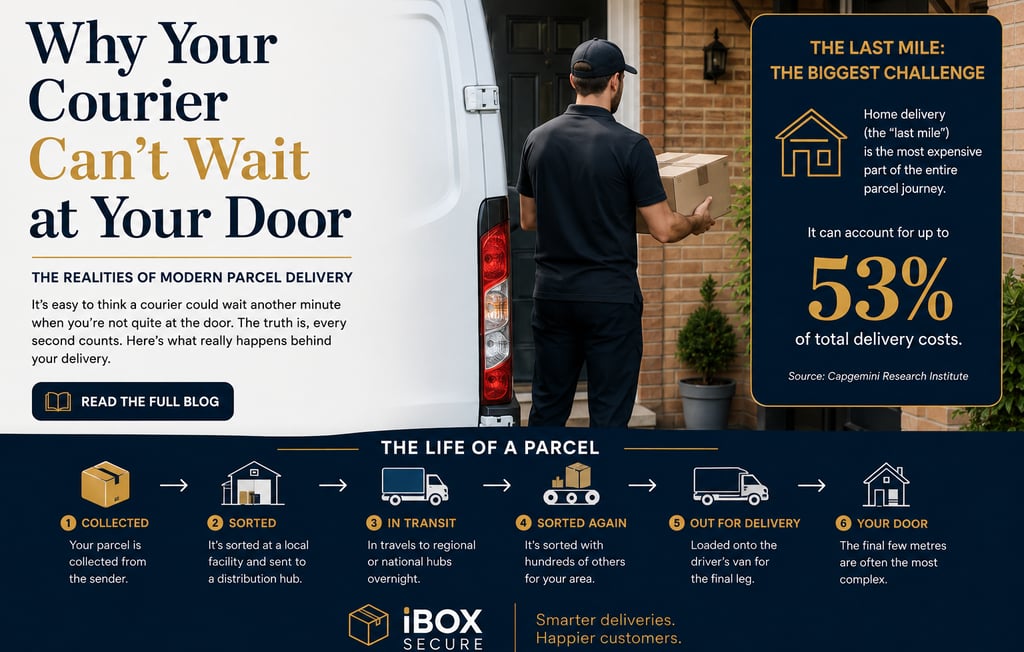
In fact, home delivery, known within the logistics industry as the "last mile", is widely recognised as the most expensive and difficult part of the entire delivery journey. It accounts for a disproportionately large share of delivery costs because every home is a separate stop, often with its own access challenges.
Understanding the challenges delivery drivers face helps explain why they sometimes seem to be in such a hurry—and why smarter delivery solutions are becoming increasingly important.
The Journey Before Your Front Door
Most people imagine their parcel starts its journey when the driver loads it into the van.
Actually, by that point, your parcel has already travelled hundreds, or even thousands, of miles.
It may have:
Been collected from a manufacturer
Passed through multiple warehouses
Been sorted by automated systems
Travelled overnight between distribution hubs
Been scanned dozens of times
Finally loaded onto a local delivery van
Ironically, the final few metres from the pavement to your front door is often the most complex and expensive part of the entire journey.
One Driver. Hundreds of Parcels.
Many people don't realise the scale of a driver's daily workload.
Depending on the route, vehicle and carrier, a driver may deliver well over 100 parcels in a day, sometimes considerably more during peak periods.
That means they don't have several minutes available at each property.
They have seconds.
If every customer delayed a driver by just one extra minute, the route could overrun by hours.
Now imagine:
150 houses
One minute extra each
That's 2½ hours added to the working day.
Those lost minutes accumulate quickly.
Every House Is Different
Unlike delivering to businesses, every home presents a different challenge.
A driver never knows whether they will find:
Locked gates
Long driveways
Apartment blocks
Entry codes
Security doors
Shared entrances
Dogs
Building work
Difficult parking
Narrow roads
Even finding the correct property can sometimes take several minutes.
One incorrect house number or missing apartment number can stop the entire route. Incorrect or incomplete address information is a major cause of delivery failures.
Parking Is Harder Than You Think
Stopping outside a house isn't always straightforward.
Drivers often have to:
Find legal parking
Avoid blocking traffic
Avoid bus stops
Avoid double yellow lines
Carry heavy parcels
Walk considerable distances
In busy towns and cities, simply finding somewhere to stop can consume valuable time, and parking search time is a recognised operational challenge in last-mile logistics.
Customers Aren't Always Home
This is perhaps the biggest challenge.
Many deliveries happen during normal working hours.
That means:
People are at work.
Parents are on the school run.
Elderly residents may be at appointments.
Shift workers may be asleep.
The driver has arrived exactly when planned...
...but nobody answers.
Now the driver must decide:
Wait?
Leave in a safe place?
Try a neighbour?
Return later?
Take it back?
Each decision takes time.
The Safe Place Dilemma
Customers often ask:
"Why didn't they just leave it behind the bin?"
Sometimes they do.
But sometimes they legally can't.
Drivers have to consider:
Is the parcel visible?
Will it stay dry?
Could it be stolen?
Has the customer authorised it?
Is it age-restricted?
Does the retailer prohibit safe-place delivery?
Making the wrong decision could result in complaints, compensation claims or disciplinary action.
Every Failed Delivery Costs Money
A failed delivery doesn't simply inconvenience the customer.
It creates a chain reaction.
The parcel may need:
Returning to the depot
Resorting overnight
Reloading
Redelivering
Additional customer service support
New route planning
Industry sources consistently identify failed first-time deliveries as one of the biggest operational costs in last-mile logistics because they increase mileage, labour and fuel use.
Technology Has Helped—but It Isn't Perfect
Today's drivers rely heavily on technology.
Their handheld devices manage:
Route optimisation
Navigation
Customer updates
Proof of delivery
Photographs
Electronic signatures
Real-time tracking
These systems improve efficiency but also mean drivers are expected to keep moving. Electronic proof-of-delivery tools help create an audit trail while reducing paperwork at each stop.
Customer Expectations Keep Rising
Consumers now expect:
Next-day delivery
Same-day delivery
Live tracking
One-hour time slots
Evening delivery
Weekend delivery
Free delivery
Every new expectation increases pressure on logistics companies to complete more deliveries in less time. The growth in e-commerce and demand for faster delivery have significantly increased last-mile complexity.
Seasonal Peaks Make Everything Harder
Think about:
Black Friday
Cyber Monday
Christmas
Amazon Prime events
Parcel volumes can surge dramatically during these periods, placing extra strain on vehicles, depots and delivery networks.
Weather Changes Everything
Rain.
Snow.
Flooding.
Ice.
High winds.
Road closures.
Every weather event affects delivery schedules.
Drivers are still expected to complete their rounds safely, even when conditions slow them down.
Then There's Parcel Theft
Drivers are increasingly aware that leaving a parcel in the wrong place may expose it to theft.
No courier wants to be responsible for a stolen delivery.
That means many choose not to leave parcels unless they're confident it's safe.
Why Delivery Drivers Deserve More Credit
The next time your courier seems rushed, remember:
They aren't trying to provide poor service.
They're trying to complete one of the most demanding jobs in modern logistics.
Every day they balance:
Customer expectations
Time pressure
Traffic
Parking
Technology
Safety
Security
Weather
Heavy lifting
Tight delivery schedules
Most drivers genuinely want every parcel delivered first time—but they're working within significant operational constraints.
A Better Way Forward
The logistics industry is already investing in solutions such as parcel lockers, collection points and improved delivery technology to reduce failed deliveries and make routes more efficient. These approaches reduce repeat visits and allow drivers to complete more successful deliveries in a single stop.
For homeowners, secure home delivery boxes offer another option. Instead of hoping someone is at home or relying on an exposed "safe place", a secure delivery box allows a courier to complete the delivery quickly and safely in a single visit.
For the customer, it means greater convenience.
For the courier, it means less waiting, fewer failed deliveries and a smoother route.
For retailers, it can mean lower costs and happier customers.
Contact
Reach out anytime for support or questions.
Phone
sales@iboxsecure.co.uk
+44 1925 500 139