
The Hidden Cost of Failed Parcel Deliveries
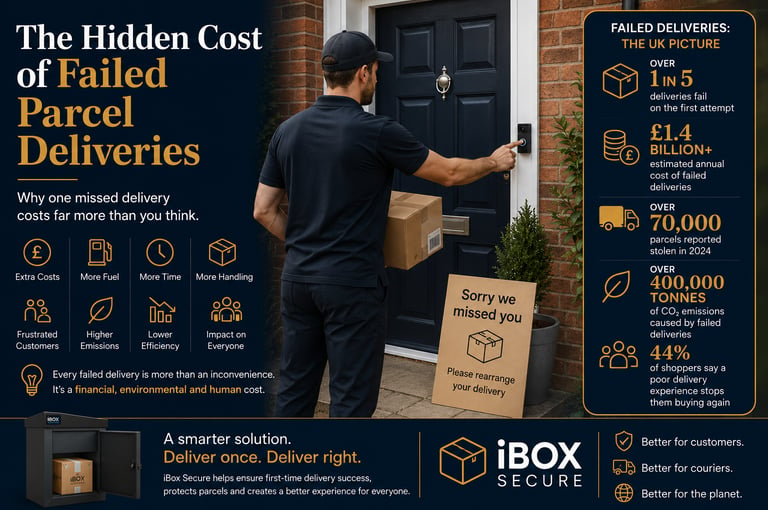
A missed parcel is more than an inconvenience. Explore the hidden financial, environmental and operational costs of failed deliveries, and how first-time delivery solutions benefit everyone.
Mark Naylor
7/7/20264 min read
Why One Missed Delivery Costs Far More Than You Think
"A courier knocks on the door. Nobody answers. They leave a card and drive away."
To most homeowners, that seems like the end of the story.
In reality, it is only the beginning.
Behind every failed delivery lies a complex chain of events involving drivers, depots, customer service teams, retailers, transport planners and, ultimately, the customer waiting for their parcel.
Multiply that by thousands of failed deliveries every day across the UK, and the financial impact quickly reaches hundreds of millions of pounds each year.
So what really happens when nobody answers the door?
The Journey Doesn't End at Your Door
Imagine a courier arrives at your home.
They've driven across town, found somewhere to park, walked to your front door carrying your parcel and rung the bell.
No answer.
Now they have several options:
Wait longer
Leave it in a safe place
Try a neighbour
Attempt another delivery later
Return it to the depot
Each decision has a cost.
Each additional minute means another customer waits longer.
The Real Cost Starts Immediately
Many people think the driver simply moves on to the next house.
Unfortunately, the parcel hasn't been delivered.
It now becomes a problem that needs solving.
That parcel now requires:
✓ More fuel
✓ More labour
✓ More vehicle time
✓ More scanning
✓ More administration
✓ More customer communication
✓ More warehouse handling
All because nobody answered the door.
The Driver's Time
Let's begin with the delivery driver.
Every route is carefully planned.
Drivers often have well over 100 stops each day.
When one delivery fails they may have to:
Walk back to the van.
Update the handheld computer.
Take photographs.
Record why delivery failed.
Leave a calling card.
Secure the parcel again.
Reload the van.
Plan another attempt.
What should have taken 30 seconds may now take several minutes.
Multiply that across an entire route and the delays become significant.
The Vehicle Cost
Delivery vans are expensive to operate.
Every additional mile costs money through:
Fuel
Tyres
Brakes
Insurance
Vehicle depreciation
Servicing
Road tax
Congestion
If a parcel requires another journey tomorrow, the vehicle incurs many of the same costs again.
The van was already outside your house once.
Now it has to return.
The Hidden Cost Inside the Depot
Most customers never see what happens next.
The driver returns to the depot.
The parcel must now be:
Scanned.
Unloaded.
Sorted again.
Stored overnight.
Loaded onto another vehicle.
Scanned once more.
Scheduled for tomorrow's route.
Every one of those steps involves equipment, warehouse space and staff.
Customer Service Costs
Meanwhile, the customer receives a notification.
Many people immediately:
Call customer services.
Open a live chat.
Send an email.
Contact the retailer.
Each contact costs money.
One missed parcel may involve several people before it is finally delivered.
Retailers Pay Too
The retailer has already sold the product.
Now they must deal with:
Where is my parcel?
Can I change the address?
Can you redeliver tomorrow?
Can I collect it?
Has it been stolen?
Even though the retailer didn't cause the failed delivery, they often carry much of the customer dissatisfaction.
Poor delivery experiences can reduce repeat purchases and increase refund requests.
The Cost of Lost Productivity
Imagine a driver carries 140 parcels each day.
If only ten deliveries fail...
The driver may spend an additional:
finding neighbours
writing calling cards
taking photographs
reloading parcels
updating delivery systems
Those small delays add up to a significant amount of lost productive time.
That time could have been spent delivering more parcels.
Environmental Costs
Every failed delivery has an environmental impact.
Extra journeys mean:
Higher fuel consumption.
More congestion.
Greater emissions.
Additional depot handling.
More energy used by warehouses.
Reducing failed deliveries isn't just about convenience—it's also about making logistics more efficient and sustainable.
The Human Cost
Customers become frustrated.
Drivers become stressed.
Customer service teams receive complaints.
Warehouse teams handle more parcels.
Managers investigate issues.
Everyone loses time.
The pressure affects the entire supply chain.
Why Drivers Sometimes Leave Parcels in Strange Places
Customers often wonder why parcels are found:
Behind bins.
Inside recycling boxes.
Behind plant pots.
In greenhouses.
Inside sheds.
The answer is simple.
Drivers are trying to avoid creating another failed delivery.
They're balancing security, customer instructions and the need to keep moving.
What Happens During Peak Season?
Now imagine Christmas.
Instead of delivering 140 parcels...
The driver may have 200 or more.
Parcel volumes surge.
Every failed delivery becomes even more expensive because:
Routes are already full.
Temporary staff require training.
Depots operate longer hours.
Customer enquiries increase dramatically.
The entire network becomes less efficient.
Why "I'll Be Home in Five Minutes" Doesn't Work
One of the most common customer requests is:
"I'm only five minutes away."
Unfortunately, drivers usually can't wait.
Those five minutes may mean:
Ten customers receive their parcels late.
School traffic is encountered.
Collection deadlines are missed.
The driver's legal working hours increase.
One customer waiting can affect dozens more.
The Domino Effect
Think of parcel delivery as a line of dominoes.
One failed delivery leads to:
Another depot scan.
Another warehouse movement.
Another customer notification.
Another journey.
Another delivery attempt.
Another opportunity for something to go wrong.
The costs keep increasing.
Who Ultimately Pays?
Although customers don't receive a bill for failed deliveries, somebody always pays.
The costs are absorbed by:
Courier companies.
Retailers.
Manufacturers.
Insurance companies.
Ultimately, higher operating costs influence delivery pricing and retail margins across the supply chain.
Breaking the Cycle
The logistics industry has invested heavily in:
Collection lockers.
Click and Collect.
Neighbour delivery.
Safe place technology.
Improved route optimisation.
Delivery apps.
These innovations all aim to increase the number of successful first-time deliveries because every successful first attempt saves time, labour and money.
A Smarter Solution at Home
There is one part of the delivery process that homeowners can control.
Making sure a courier has a secure, reliable place to leave a parcel—even when nobody is at home.
A smart delivery box provides that certainty.
Instead of:
❌ Returning to the depot
❌ Rearranging another delivery
❌ Leaving a parcel exposed
❌ Searching for a neighbour
The courier can complete the delivery safely in one visit.
For the homeowner, that means greater convenience.
For the retailer, it means fewer customer service issues.
For the courier, it means a more efficient route.
For the environment, it means fewer unnecessary journeys.
Final Thoughts
Every missed delivery may seem insignificant, but across millions of parcels each year the impact is enormous.
Failed deliveries consume fuel, labour, warehouse capacity, customer service resources and valuable time. They also create frustration for everyone involved—from the customer waiting at home to the driver trying to stay on schedule.
As online shopping continues to grow, improving first-time delivery success will become increasingly important. Solutions that reduce repeat journeys and make deliveries more predictable benefit the entire ecosystem.
Sometimes the biggest improvements don't come from making drivers work harder—they come from making the delivery itself simpler.
Contact
Reach out anytime for support or questions.
Phone
sales@iboxsecure.co.uk
+44 1925 500 139